By Tony Min
I have eaten black chai tow kway hundreds of times. For most of my life, it was the ultimate fallback meal. You are standing in the middle of Ghim Moh Market, the queue for your usual spot stretches around the corner, your stomach is growling, and you just need something fast. So, you point to the menu, hand over three dollars, and walk away with a messy, steaming pile of fried radish cake, egg, and sweet dark soy sauce.
I always treated it as simple comfort food, a dish built purely for speed and a quick sugar rush, completely devoid of any real complexity.
But a few mornings ago, I arrived at the market right as the stall opened. Without the usual lunchtime crowd pushing against my back, I actually stood and watched the uncle work his massive, seasoned wok. He didn’t just fry the ingredients; he coaxed them. I noticed how he poured the thick, dark soy sauce not directly onto the radish cubes, but around the hot edges of the cast iron. He let the sauce hiss, bubble, and caramelize for a crucial few seconds before folding it into the eggs.
When I finally sat down and took my first bite, I realized I had been eating this dish entirely wrong my whole life.
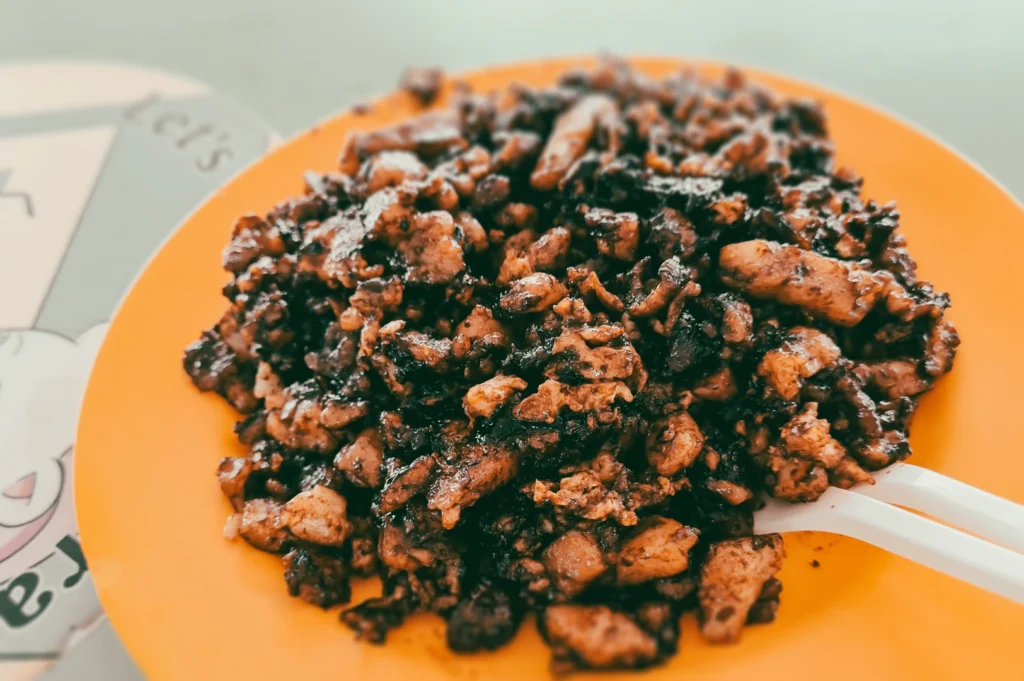
I had never paid attention to the textures. I never noticed the delicate, crispy char on the edges of the radish cake fighting against its soft, almost melting interior. I had never appreciated how the sharp, salty punch of the preserved radish (chye poh) was perfectly calibrated to cut through the heavy, molasses-like sweetness of the dark soy.
In Singapore, we do this constantly. We grow up completely surrounded by incredible, generation-spanning culinary heritage, and as a result, we become blind to its sheer brilliance. We treat historically rich, complex recipes as mere fast food because they are cheap and served on chipped melamine plates. But this messy, unassuming breakfast isn’t just a quick meal. It is an edible history of Teochew immigrants, adapted, sweetened, and reshaped by the constraints and tastes of a new island home. It is a quiet masterpiece hiding in plain sight.
I finished my plate slowly that morning, tasting the smoke and the history in every single bite. I felt a strange, quiet sense of apology toward the food. I had known its name for decades, but I had never actually paid attention to what it had to say.
We spend so much time hunting for the next big dining concept or the newest flavor profile. But sometimes, the most profound culinary discoveries aren’t found in a new reservation. They are waiting patiently at the hawker centre down the street, hoping you will finally slow down enough to taste them.
